Interview Questions
from Lay-friends
Interview Questions
from Lay-friends
Interview Questions
from Lay-friends
Interview Questions
from Lay-friends



Interview Questions from Lay-friends
Can you explain the concept of "Anatta" (translated as "No-Self") in Buddhism?
In Buddhism, the Pali term Anatta, often translated as “No-Self,” refers to the Buddha’s teachings that there is no permanent self, as all phenomena are constantly changing. The five aggregates (material form, feeling, perception, mental formations, and consciousness) are a set of interdependent processes rather than a fixed, independent self. They cause suffering because they are not permanent and they change from moment to moment. To understand the concept of “No Self,” it is important to recognize that the Buddha taught it as one of his most difficult teachings yet understanding it is key to understanding all the Buddha’s other teachings.
The Five Aggregates are:
1. Material Form is the parts of our physical body (including the eyes, ears, nose, tongue, body, and mind), which derived from the Four Great Elements.
The Four Great Elements:
-
Earth elements: solidity and durability,
-
Water elements: liquidity/fluid and moisture,
-
Wind elements: gas/air movement, and
-
Fire elements: heat and energy
Parts of the Body Elements:
-
Earth Body elements: organs, tissues, and bones
-
Water Body elements: blood, urine, and semen
-
Wind Body elements: lungs, stomach, and bowel gases
-
Fire Body elements: body’s temperature
2. Feeling occurs when a sense organ makes contact with its object. The sensations you experience in your body include our basic sense of liking, disliking, or being indifferent to whatever we perceive.
Feeling includes:
-
Sight,
-
Sound,
-
Smell,
-
Taste,
-
Body Sensations, and
-
Thoughts and ideas
3. Perception in Buddhism is the recognition of things. Feeling is sensing that something is there; however, Perception is determining what it is. For example, I hear a sound (Feeling), and I recognize it is a bird chirping (Perception).
Perception (Six External Senses):
-
Visible (knowing what you see)
-
Audible (knowing what you hear)
-
Scent (knowing what you smell)
-
Taste (knowing what you taste)
-
Touch (knowing what it is that you touched)
-
Mind (Wisdom)
4. Mental Formations are the mental actions that direct the mind with activities toward the good, the bad, or the neutral. Contrasting with Feeling and perception, which are not volitional actions, and there do not produce Karma, Mental Formations do produce good and bad Karma.
There are 52 important types of Mental Formations, which are listed in literature. Please refer to the 52 Mental Formations Chart below. Some of the most important Mental Formations are listed below:
-
Volition (Unmoral-Universals: (4) Connected with every type of Consciousness)
-
Attention (Unmoral-Universals: (7) Connected with every type of Consciousness)
-
Effort (Unmoral-Particulars: (11) Connected with Wholesome or Unwholesome types of Consciousness)
-
Mindfulness (Beautiful or Moral: (29) Connected with all Noble Lofty, Pure types of Consciousness)
-
Wisdom (Beautiful or Moral: (52) Wisdom connected with non-delusion)
-
Determination (Unmoral-Particulars: (10) Connected with Wholesome or Unwholesome types of Consciousness)
-
Confidence (Beautiful or Moral: (28) Connected with all Noble Lofty, Pure types of Consciousness)
-
Conceit (Immoral: (20) Connected with the Root of Ignorance: Connected with the Root of Anger)
-
Hatred (Immoral: (21) Connected with the Root of Ignorance: Connected with the Root of Anger)
-
Jealousy (Immoral: (22) Connected with the Root of Ignorance: Connected with the Root of Anger)
-
Delusion (Immoral: (14) Connected with the Root of Ignorance: Connected with the Root of Ignorance)
-
Desire (Unmoral-Particulars: (13) Connected with Wholesome or Unwholesome types of Consciousness)

5. Consciousness arises from the other aggregates. Consciousness is formed from our awareness of experiences and desires, while suffering comes from clinging to these negative mental states.
For example, we have a drink of something and taste with our tongue (Material Form). We sense that it is tart and pleasant (Feeling). We recognize that it is lemonade (Perception). We remember that our mom used to make lemonade for us as a treat (Mental Formation). We develop greed over lemonade and drink too much. If we recognize that all of this is happening, we can have insight into our human experiences and gain Consciousness.
Tongue when combined with the lemonade, perception, and mental formations, will produce consciousness of that object. The tongue alone cannot produce awareness.
The key point is that the five aggregates are interconnected and are constantly changing processes that together give rise to the experience of being “you.” However, none of these constitute a “self” and all are impermanent.
Law of Dependent Origination: Nothing including the “self” exists independently; everything arises through interdependent causes and conditions.
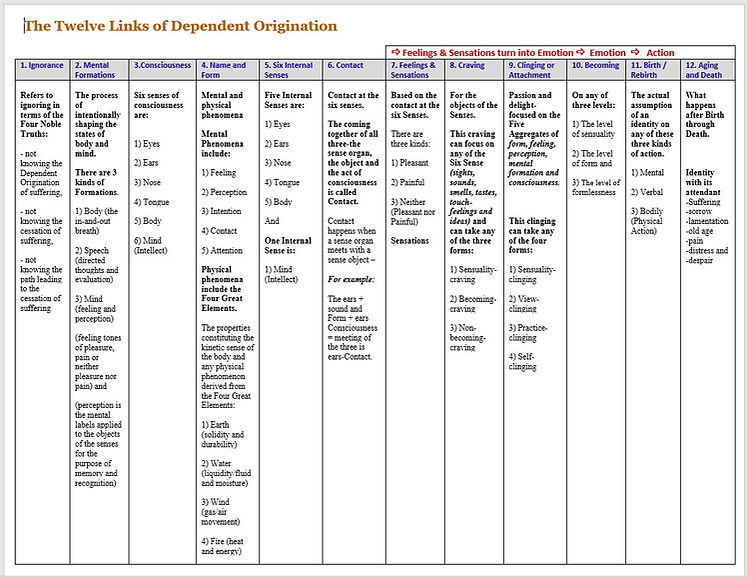
The Buddha teaches that there are twelve links in the Law of Dependent Origination. These links appear in chronological order, and they take place over three lifetimes: past, present and future.
-
Past: Ignorance and Mental Formations represent the conditions which are responsible for the occurrence of the present life.
-
Present: Consciousness, Name & Form, Six Internal Senses, Contact, Feelings & Sensations, Craving, Clinging/Attachment and Becoming constitute the process of evolution within the present life.
-
Future: Birth/Rebirth, Aging & Death including sorrow, lamentation, pain, grief, and despair represent the conditions for a future existence, which cycles us back into another life.
The cycle of links are also described in terms of the following groups:
-
Defilements: Ignorance, Craving, and Clinging/Attachment
-
Actions (karma): Mental Formations and Becoming
-
Suffering: Consciousness, Name & Form, Six Internal Senses, Contact, Feelings & Sensations, Birth/Rebirth, Aging & Death.
The 12 links are grouped into Past, Present, and Future when we’re talking about TIME. They are grouped into Defilements, Actions, and Suffering when we talk about KARMA.

The Three Universal Truths which the Buddha taught his disciples are:
I. Nothing is lost in the Universe
II. Everything changes (Impermanence)
III. The Law of Cause and Effect.
I. Nothing is Lost in the Universe
Like a rose, that blooms beautifully, and then suddenly, it withers. The components of the rose remain in the universe as it wilts. Nothing is lost. The essence of the rose is invisible to the naked eye, but it does not go anywhere. The elements of the flower will be recycled to form a new life or contribute to the existence of another.
II. Everything is Impermanent
All things are transient in this world, including change. Impermanence is the state of not being permanent, of existing only for a short period of time, and changing continually. Everything in this life changes and impermanence is one of their characteristics. Change is the only thing that remains. Impermanence teaches us to let go. We need to let go, even of those things that make us proud and happy. The reason is that we can never completely hold on to them.
“All that is subject to arising is subject to ceasing.” ~ Dhammapada Sutta
III. The Law of Cause and Effect
The Universal Law of Cause and Effect is also known as Karma. Karma means Cause and Effect (with Conditions), or Action and Consequence. There is continuous change due to the Law of Cause and Effect. Nothing is permanent, and only change is permanent.
Karma governs human actions. In everything that we do, there will always be a return of such action. This causality principle defines the doctrine of Karma.
One must attempt to understand life not just as a linear progression through time, but as a connected process that exists at every moment, essentially viewing the past, present, and future as equally relevant.
CAUSE is the primary force that produces an EFFECT. The CONDITION is a secondary force and something that is indispensable to the production of effect. In the cause, there is the effect, AND, in the effect, there is the cause. Cause and effect never conflict with each other. We shall reap what we have sown. From the present cause we can see the future effect; from the present effect we have discerned the past cause. It is necessary, however, to have some specific conditions to produce an effect. Cause combined with condition gives effect. The condition CAN change the effect, whether good or bad.
For example, if we grow apples, we will harvest apples. With fertilizer, sunlight, rain, watering, and care, the apple seed will grow and become a plant and finally produce apples. The apple seed is the cause. The soil, water, sunlight, and care are the conditions. The apples are the effect.
Buddhism emphasizes the causes that one creates and accumulates in the present, because these will be the causes to determine one’s future. Good deeds yield good results, while bad deeds yield bad results. The phenomenon occurs by one’s own cause, and one’s own effect, like planting a seed. You won’t get a watermelon if you did not plant a watermelon seed. However, the conditions are an important factor of whether the seed will flourish.
References:
“Chơn Lý,” Tác Giả Đức Tổ Sư Minh Đăng Quang (Language in Vietnamese)
“Phật Học Phổ Thông,” Tác Giả Hòa Thượng Thích Thiện Hoa (Language in Vietnamese)
“The Seeker’s Glossary of BUDDHISM,” Edited by the Van Hien-Study Group, Sutra Translation Committee of the United States & Canada
“A Simple Path – Basic Buddhist Teachings,” by His Holiness the XIV Dalai Lama
"The Agendas of Mindfulness," by Thanissaro Bhikkhu. Access to Insight (BCBS Edition), 5 June 2010, http://www.accesstoinsight.org/lib/authors/thanissaro/agendas.html.
“The Buddha and His Teachings,” by Venerable Narada Mahathera (Sri Lanka 1970), Buddha Dharma Education Association Inc.
“Vipassana Research Institute,” by Mahasatipattha Sutta. India Apollo Printing Press (2006)
“Buddhism,” from Wikipedia, the free encyclopedia, en.wikipedia.org/wiki/Buddhism.
"Realbuddhaquotes.com"

